Abstract
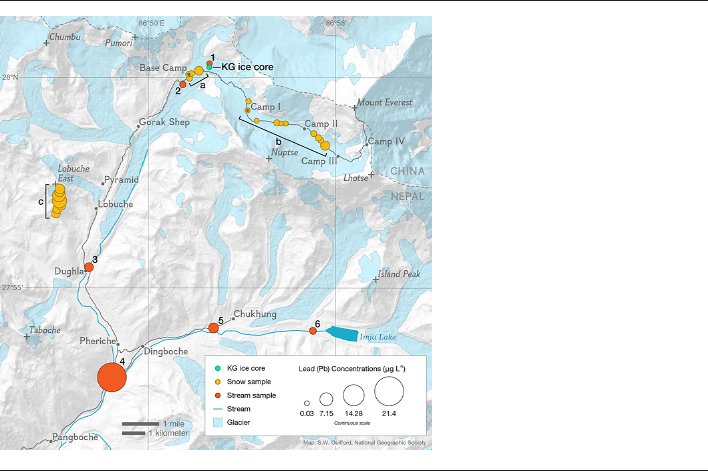
This case study provides a framework for future monitoring and evidence for human source pollution in the Khumbu region, Nepal. We analyzed the chemical composition (major ions, major/trace elements, black carbon, and stable water isotopes) of pre-monsoon stream water (4300–5250 m) and snow (5200–6665 m) samples collected from Mt. Everest, Mt. Lobuche, and the Imja Valley during the 2019 pre-monsoon season, in addition to a shallow ice core recovered from the Khumbu Glacier (5300 m). In agreement with previous work, pre-monsoon aerosol deposition is dominated by dust originating from western sources and less frequently by transport from southerly air mass sources as demonstrated by evidence of one of the strongest recorded pre-monsoon events emanating from the Bay of Bengal, Cyclone Fani. Elevated concentrations of human-sourced metals (e.g., Pb, Bi, As) are found in surface snow and stream chemistry collected in the Khumbu region. As the most comprehensive case study of environmental chemistry in the Khumbu region, this research offers sufficient evidence for increased monitoring in this watershed and surrounding areas.
Key figure