Weather
Authors

Tenzing Chogyal Sherpa

Tom Matthews

L. Baker Perry

Amrit Thapa

Praveen Kumar Singh ORCID iD

Arbindra Khadka

Inka Koch

Mauri Pelto

Prajjwal Panday

Deepak Aryal

Dibas Shrestha

Shichang Kang

Paul Andrew Mayewski

Published

March 20, 2023

Publication PDF

Abstract

The highest reaches of our planet experience some of the most extreme weather on Earth and hold very significant supplies of freshwater for communities downstream. However, we know very little of the meteorological detail about this high-altitude frontier. We address this here with new winter weather observations from the upper reaches of Mount Everest (2019–2021). We show that substantial sublimation rates are possible, with losses up to 2.5 mm day−1. Wind chill plunging to −83°C and frostbite possible in less than one minute also attest to the severe cold stress facing mountaineers attempting winter ascents of this most iconic peak.

Key figure
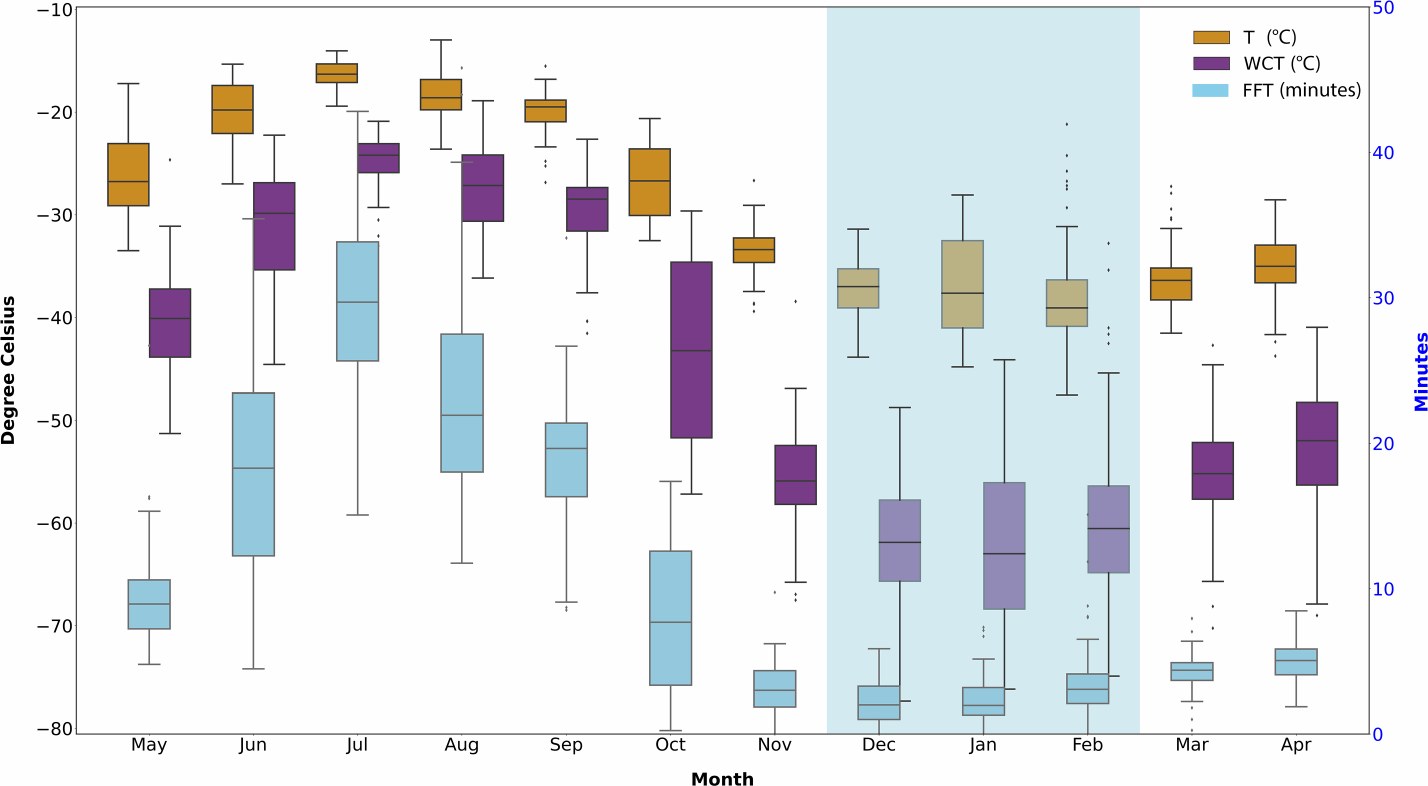
Box plots of monthly air temperature, wind chill temperature and facial frostbite time at the summit of Mount Everest, May 2019 to April 2020

Fig. 2 from Sherpa et al. (2023): daily mean air temperature (T), wind chill temperature (WCT) and facial frostbite time (FFT) estimated at the summit of Mount Everest; the shaded band marks winter. © 2023 Royal Meteorological Society.
Back to top